YouTube Music AI Labels: Know If a Song Is AI-Made
YouTube Music AI labels are now rolling out to show you when a song was created primarily with generative AI, right on the player page. Announced on October 14, 2026, the new labels are YouTube's answer to a simple question listeners keep asking: was this song made by a person, a machine, or a mix of both?
AI-generated music has exploded across streaming services over the past year. Tools that can write a melody, produce a beat, and even sing the vocals are now available to anyone, leaving many listeners unsure about what they are hearing. YouTube's new labels are designed to clear that up, without banning AI music outright.
What Are the New YouTube Music AI Labels?
When you play a track on YouTube Music where AI played a significant role, you will now see a small "AI" label directly on the player page. Tapping it opens a menu that explains what the AI actually did — whether it created the composition, the vocals, or both.
The labels are rolling out on YouTube Music first, and YouTube says they will also expand to the main YouTube app: clear information at the moment you press play, so you can decide for yourself what you want to listen to.
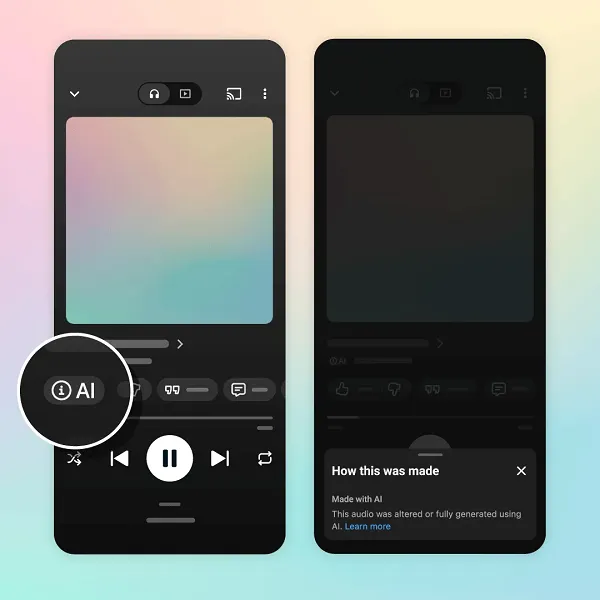
Image: YouTube
The Three YouTube Music AI Labels Explained
YouTube is not using a single vague "AI" stamp. Music partners can declare how generative AI was used through one of three designations when they deliver a track to YouTube:
1. Fully Gen AI
This label means the track was created entirely by AI. A generative model produced the composition and the vocals, with no meaningful human performance in the recording.
2. Partly Gen AI
This label covers songs that mix AI-generated parts with real human elements. For example, an artist might use an AI-generated backing track but sing the vocals themselves, or add live instruments over an AI-produced beat.
3. No Gen AI
This label means no generative AI was used in a significant way. Everyday production tools still count as "No Gen AI" — including pitch-correction tools like Auto-Tune. In other words, using standard studio software does not make a song "AI-generated" in YouTube's eyes.
Partners declare these designations when they deliver music to YouTube, using standard delivery templates. YouTube then combines those declarations with its own detection tools to decide which tracks get labeled.
How YouTube Decides What Gets a Label
The system relies on two sources of information working together:
- Partner declarations: Labels, distributors, and artists state how much generative AI went into each track when they upload it.
- YouTube's own detection tools: YouTube runs its own technology to spot AI-generated music, applying the same labeling principles it already uses for AI content across YouTube.
Neither method is perfect alone — self-reporting depends on honesty, and detection can err — so combining them gives listeners a more reliable signal.
One important detail: getting an AI label does not mean a track loses its ability to earn money. Disclosure alone does not make a song ineligible for monetization. However, failing to declare AI use when it is required can lead to penalties or removal. The message to artists is clear: be honest about AI, and your music stays up.
What This Means for You as a Listener
For everyday listeners, the change is simple:
- You can spot AI-made songs instantly. No more guessing whether that catchy new track came from a bedroom artist or a prompt. The label is right there on the player page.
- You can make informed choices. Some people enjoy AI-generated music and do not care how it was made. Others want to support human artists. The label lets both groups listen the way they prefer.
- You can learn what "AI" actually means for each song. Tapping the label shows whether AI wrote the music, sang the vocals, or both.
It is also worth knowing what the labels do not do. A label is not a quality rating, and it does not mean a song is fake or illegal. It is simply a disclosure of how the track was made.
What This Means for Artists and Creators
If you make music, the new labels change how you should think about releasing it:
- Declare your AI use honestly. If generative AI played a significant role in your track, say so when you deliver it. Honest disclosure keeps your music monetized and avoids penalties.
- Using AI tools is not a ban. YouTube is not pushing AI music off the platform. The company itself experiments with AI music creation — for example, its Dream Track tool lets select creators generate soundtracks featuring AI-generated versions of participating artists' voices.
- Transparency can build trust. Listeners increasingly value knowing how music is made. Being upfront about AI assistance can strengthen your connection with fans.
How YouTube Music Compares to Spotify, Apple Music, and Deezer
YouTube is not alone. Nearly every major streaming service is now grappling with the same flood of AI-generated music — and each is handling it differently:
- Deezer has taken one of the strictest stances. The company reported receiving nearly 90,000 fully AI-generated tracks every day in July 2026. Deezer labels detected AI music, keeps it out of recommendations and editorial playlists, and withholds royalties from fraudulent streams.
- Apple Music plans to introduce "Made With AI" labels as part of its AI Transparency Tags later this year.
- Spotify already uses AI labels and runs a music spam filter to catch low-quality AI content.
- TIDAL labels recordings it identifies as entirely AI-generated, lets listeners hide them, and excludes them from royalty attribution.
YouTube's approach sits in the middle: disclose, don't block. AI involvement alone does not remove a track or cut off its earnings. YouTube is betting that transparency, rather than restriction, is what listeners actually want.
The pressure for labeling is not just coming from platforms. Over the summer of 2026, major music industry groups — including the RIAA, IFPI, the Grammys, and SAG-AFTRA — banded together to push for a standard labeling program using "AI-Generated" or "AI-Assisted" indicators. In Australia, an AI-generated remix of Madonna's "Like a Prayer" recently topped the local charts, prompting the Australian Recording Industry Association to require that chart music be substantially human-made.
What to Do Next
Here is how to use the new labels:
- Open YouTube Music and play a track you suspect might be AI-made. Look for the AI label on the player page and tap it to see the details.
- Check the details, not just the badge. "Partly Gen AI" and "Fully Gen AI" mean very different things.
- If you are an artist, review your uploads. Make sure your AI disclosures are accurate, so your music stays in good standing.
- Keep an eye on the main YouTube app. The same labels are coming there soon, covering music videos and other music content beyond YouTube Music.
What is changing is how much you get to know about it. With these labels, YouTube is giving listeners something simple but powerful: the facts, right where the music plays. For more on AI in everyday apps, see our more AI news and more technology news coverage.
Sources: YouTube Official Blog, TechCrunch, Music Business Worldwide


Discussion
// Sign in with Google to join the discussion (Settings → Comments to change who can comment)