Nvidia DSX POD: Full AI Data Center in a Container
What Is the Nvidia DSX POD?
Nvidia's DSX POD packs a complete Vera Rubin AI factory into a shipping container, cutting data-center deployment time from six months to 14 days. Announced by CEO Jensen Huang during his GTC Berlin keynote on October 21, 2026, the DSX POD is a reference design that partners build inside modular containers, fully integrate and validate at the factory, then ship ready to connect.
Think of it like a pre-built house versus building one from scratch. Normally, setting up an AI data center means months of on-site construction: wiring racks, installing cooling pipes, testing every cable. With the DSX POD, all of that happens at the manufacturing plant. When the container arrives at the customer's site, workers only need to hook it up to power, cooling, and the network — and it starts running AI models for real services, which Nvidia calls "time to first token."
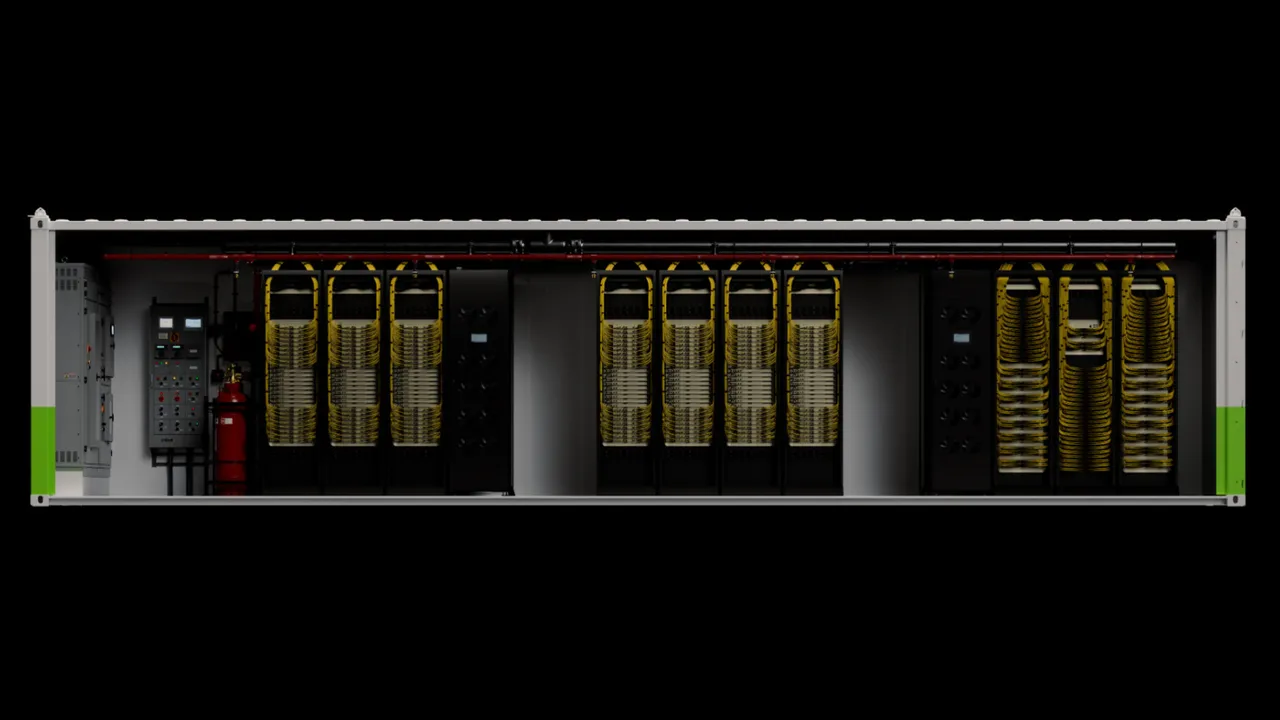
Image: NVIDIA
What's Inside the Box
A single DSX POD container — weighing about 28 metric tons — carries serious computing power:
- Seven liquid-cooled Vera Rubin NVL72 racks, packing 504 GPUs and 252 Vera CPUs, the computing muscle that trains and runs AI models.
- Networking and cabling pre-installed, including 17 kilometers of Spectrum-X networking cables that connect everything together.
- Rack-level power and liquid cooling, installed and plumbed before the container ever leaves the factory.
- Full functional validation — every fitting, cable, and component is tested at the plant, so problems are caught before delivery instead of during a stressful on-site build.
Vera Rubin is Nvidia's next-generation AI computing platform, and the DSX POD is the first product family built around it to arrive in containerized form. Because it is a reference design, partners such as Dell Technologies, HPE, Lenovo, Schneider Electric, Eaton, Vertiv, and others can each build and sell their own versions — and customers can pick whichever vendor they prefer for each part of the system.
From 6 Months to 14 Days: How It Works
The trick is moving the hard work off the construction site and into the factory. Traditionally, a data center build involves detailed planning, on-site construction, specialized labor, and logistics — all exposed to part delays and human error. The DSX POD flips this around:
- At the factory: partners complete rack-to-rack cabling, wiring, piping, and functional testing inside the container.
- At the site: crews prepare utilities — power, cooling, and network connections — while the container is being built.
- At delivery: the pre-tested container arrives, plugs into the site's utilities, and goes live in as little as 14 days.
"This is a fully assembled, fully tested, fully pre-plumbed, prebuilt, pre-validated container that is the building block for AI factories," said Ian Buck, Nvidia's vice president of hyperscale and high-performance computing, in a media briefing. "It's designed to accelerate Europe's infrastructure deployment and dramatically shorten the time to first token."
Nvidia deliberately announced the design at GTC Berlin because it sees modular, faster-to-deploy infrastructure playing an important role in Europe's AI capacity expansion — though the company says the containers are intended for worldwide deployment.
Why Speed Means Money
Nvidia's argument is simple: an AI data center only creates value once it starts "producing tokens" — the units of text and data that AI models process and generate. Every month spent on construction is a month of lost revenue.
"An AI factory creates value when it starts producing tokens — not when construction is complete," Huang said during the keynote. "With NVIDIA DSX POD, we're bringing factory-built precision and speed to AI infrastructure construction — reducing deployment time from months to weeks so customers can scale capacity and bring revenue-generating production online faster."
To underline the point, Huang put numbers on the scale of modern AI infrastructure: a one-gigawatt data center costs about $50 billion (land, power, equipment, cooling, and networking), and such a facility could generate around $40 billion in annual revenue — meaning a three-month construction delay could push back roughly $10 billion in revenue. Investors noticed: Nvidia's stock climbed nearly 2% to $220.50 after the announcement.
Industry watchers say the DSX POD could appeal to three kinds of customers, according to IDC analyst Ashish Nadkarni:
- Sovereign AI deployments — countries and governments that need physically isolated AI infrastructure of their own.
- Smaller-footprint deployments — organizations that need AI compute for specific projects without building a full data center.
- Edge AI environments — locations where AI processing must happen close to users or devices.
What It Means for the AI Boom
The DSX POD lands at a moment when demand for AI computing is outpacing the ability to build data centers. DatacenterKnowledge notes the announcement came alongside Nvidia's broader manufacturing expansion: the company and its supply chain partners plan to increase substrate capacity 2.5 times over three years and expand advanced packaging capacity by more than 300% by 2028.
Here are the practical takeaways:
- Data centers are becoming a product, not a project. Factory-built, repeatable designs mean AI compute can be ordered, delivered, and plugged in — closer to buying equipment than running a construction site.
- Modularity scales one container at a time. Need more capacity? Add another DSX POD instead of planning a new building.
- Vendor choice stays open. With 17 partners — including Anduril, Armada, Bull, Crusoe, DayOne, Dell Technologies, Delta, Eaton, Foxconn (Ingrasys), GIGABYTE, HPE, Lenovo, Pegatron, Quanta Cloud Technology, Schneider Electric, Vertiv, and Wistron — customers can mix and match.
- Availability is coming soon. Partners expect to begin delivering DSX POD AI factories worldwide in early 2027.
The AI boom's bottleneck is shifting from chips to construction speed. If Nvidia's container math holds up, the next wave of AI factories may arrive the way shipping containers do — pre-built, pre-tested, and ready to plug in. For more on the AI infrastructure race, check out more AI news and more technology news.
Sources: NVIDIA press release (GlobeNewswire), Data Center Knowledge, The Hindu, The Register


Discussion
// Sign in with Google to join the discussion (Settings → Comments to change who can comment)