Kimi K3.1 Pro: Moonshot's Open AI Model Explained
What Is Kimi K3.1 Pro?
Moonshot AI's Kimi K3.1 Pro is the most powerful open-weight AI model the Chinese lab has released so far, and it arrives with a deliberate safety twist.
Announced on October 23, 2026, Kimi K3.1 Pro is the first model in Moonshot's new K3.1 series. The Beijing-based company describes it as its most capable 3-trillion-parameter-class open-weight model to date, a post-trained version of the earlier Kimi K3 built with substantially more post-training compute.
If the phrase "open-weight model" is new to you, here is the simple version. Most famous AI models run only on their makers' servers: you can use them, but you cannot download the model itself. An open-weight model is different — the maker publishes the model's "weights," the huge set of numbers it learned during training, so developers can download them and run the model on their own computers. That means more control and privacy.
There is one important detail, though. The weights for Kimi K3.1 Pro are not out yet. Moonshot says the full model weights will be released by November 4, 2026, and the licence they will carry has not been announced yet. Until then, you can use the model through Moonshot's own products and API.
Kimi K3.1 Pro Specs: Big, Fast, and Multimodal
Kimi K3.1 Pro is built on a mixture-of-experts design, with 2.8 trillion total parameters and 104 billion active parameters. In plain English, it is a giant team of specialists: for each question, only a small slice wakes up to answer, which keeps it fast despite its size.
It also has a 1-million-token context window. A token is roughly a word fragment, so 1 million tokens means the model can work with enormous documents — entire codebases, long reports, or hundreds of pages — in one conversation. The model handles both text and images, and Moonshot is also releasing Kimi K3.1 Pro Highspeed, which it says runs two to three times faster for more responsive chats.
Image: Moonshot AI
What Can Kimi K3.1 Pro Actually Do?
Three areas stand out: coding, 3D creation, and finance.
Coding and Agentic Work
On Terminal-Bench 4.0, a test that grades coding agents on realistic terminal-based tasks, Moonshot reports that Kimi K3.1 Pro scores 65.7%, ahead of GPT-6 Astra at 58.2% and narrowly behind Claude Opus 5.5 at 66.4%. On the company's own long-horizon coding test, Kimi Code Bench 3.0, it scores 61.2%, up from K3's 55.95%. These are Moonshot's own numbers, not independent results, so treat them as the company's claims rather than verified facts.
Independent benchmarker Artificial Analysis gives a useful second opinion: it scores Kimi K3.1 Pro at 55 on its Intelligence Index, fourth overall behind only Claude Opus 5.5, Claude Sonnet 5.5, and Muse Wonder Full. That would make it the highest-scoring open-weight model once its weights are published. In practice, Moonshot says the model covers the full range of coding work, from quick fixes in real codebases to complete project builds, including games built with Unity, Unreal Engine, and Godot.
3D Creation
Kimi K3.1 Pro is also strong at 3D creation. On BenchCAD, which tests turning descriptions or reference images into 3D models through CAD code, it scores 92.7% with tools, approaching Claude Opus 5.5 at 96.2% and GPT-6 Astra at 95.9%. Moonshot has also launched 3D Make, a feature that lets you preview and edit 3D models online, download them ready for 3D printing, or export them as videos. It is live on kimi.ai and in the Kimi app.
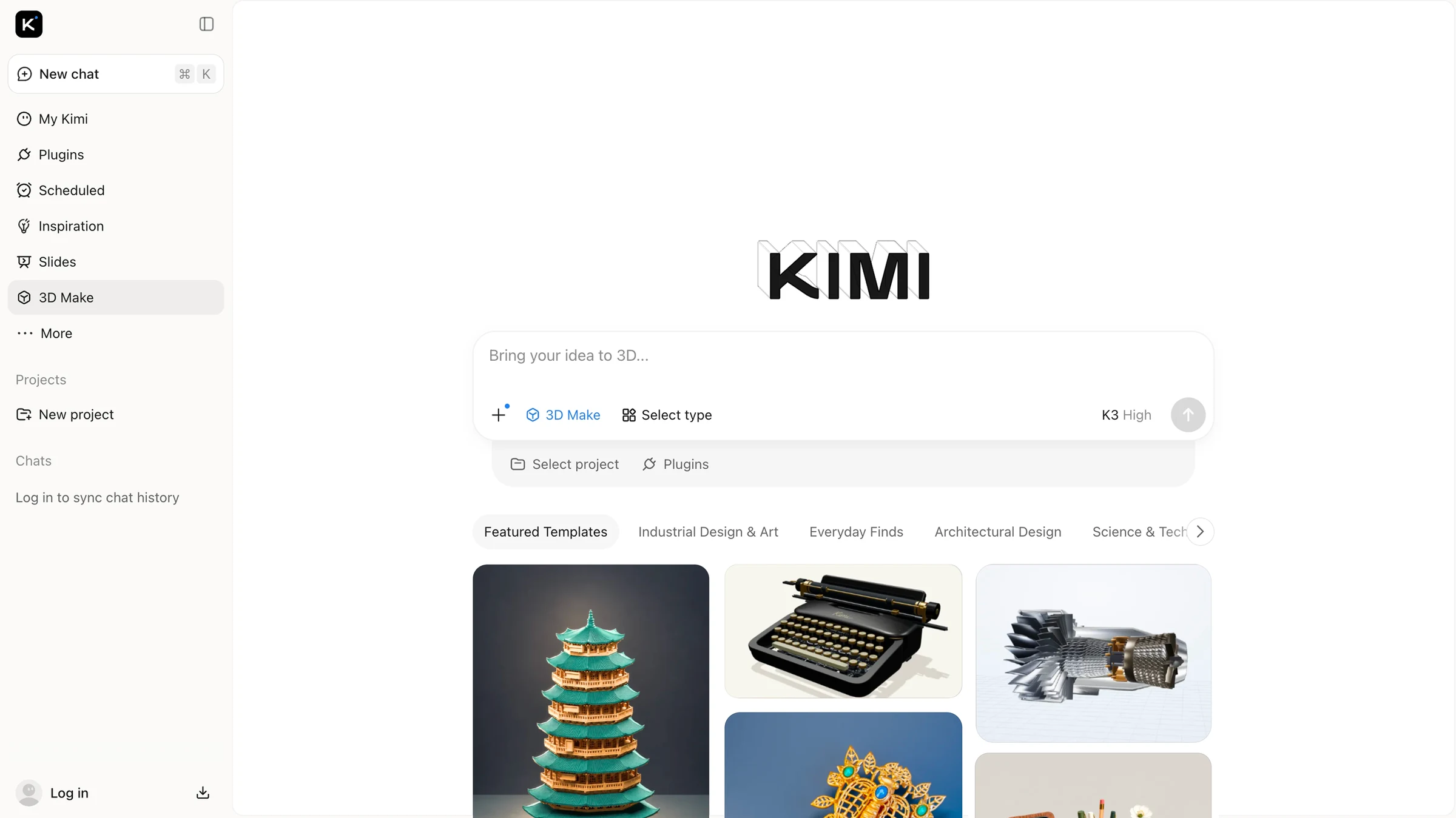
Image: Moonshot AI
Finance Work
For finance, Moonshot reports a state-of-the-art result of 64.4 on OfficeQA Pro v2, a test of complex fiscal data analysis across real financial documents. Accuracy also improved: on Moonshot's own Kimi Hallu Bench Hard stress test, the claim-level hallucination rate fell from 23.4% for K3 to 8.3% for K3.1 Pro. Moonshot notes this is a stress test with deliberately tricky examples, so the numbers do not represent everyday error rates.
The Safety Twist: Deliberately Weaker at Hacking
Here is the part that makes this launch unusual. As Kimi K3.1 Pro got more capable, Moonshot found that its vulnerability-research ability was growing too — the skill of finding and exploiting security flaws in software. Because the weights will soon be public, Moonshot deliberately dialed that ability back.
The company identified and removed cyber-related data from both the mid-training corpus and the reinforcement-learning environments used to develop the model, while keeping the general coding skills that make the model useful. Moonshot's stated goal is clear: "We aim not to release open weights that would extend the absolute frontier of cyber capability."
The effect is measurable. On Moonshot's in-house xdev-bench-hard test of finding and exploiting real vulnerabilities, the version without the safety measures solved 90.5% of problems, while the final Kimi K3.1 Pro solved 81.0% — still a big jump over K3's 33.3%. Moonshot acknowledges that stronger general coding skills partly transfer to cyber tasks even after the data removal, but the gap shows the controls did something real.
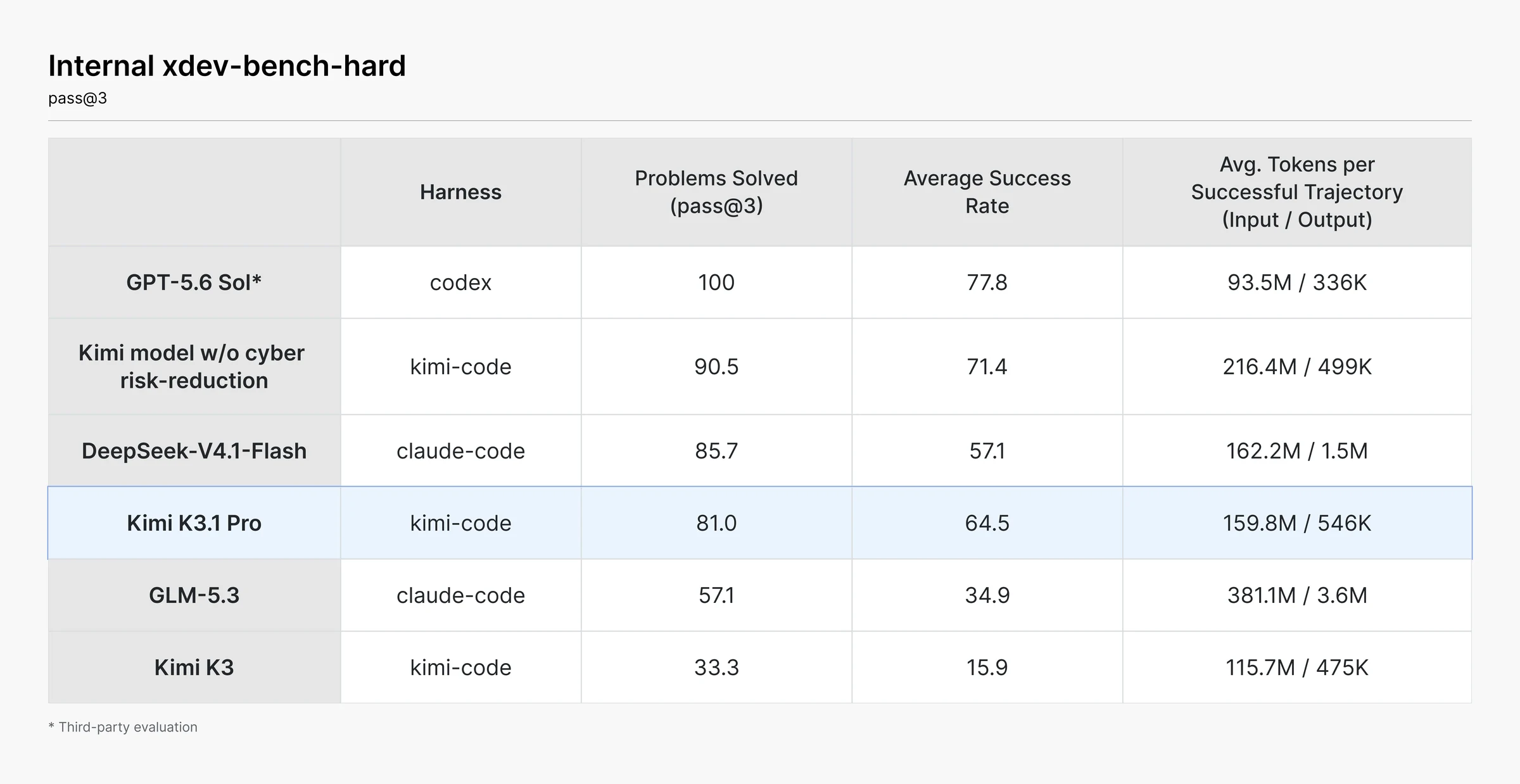
Image: Moonshot AI
This matters because open weights are a double-edged sword. Once the files are widely shared, the original developer cannot take them back or push safety updates the way a hosted service can. Moonshot argues the trade-off is worth it: open models let many more teams audit the code they maintain, including older, rarely reviewed systems. The timing is also notable, coming days after China proposed draft export controls that would restrict AI-driven malware-generation technology.
Kimi K3.1 Pro Price and Where to Try It
Kimi K3.1 Pro is available now on kimi.ai and the Kimi mobile apps for iOS, Android, and HarmonyOS, as well as in Kimi Work (version 3.1.0 or later) and Kimi Code, where you select it with the /model command. Developers can also use it through the Kimi API as kimi-k3.1-pro or kimi-k3.1-pro-highspeed, with zero data retention available for API customers. API pricing is $2 per million input tokens and $10 per million output tokens, with cached input at $0.20 — a 33% cut from K3's prices. The Highspeed version costs $4 and $20 respectively. For businesses, Kimi Enterprise access is off by default at launch and must be enabled by administrators.
Why Kimi K3.1 Pro Matters
Here are the practical takeaways:
- Open models are catching up. An open-weight model now sits just behind the best closed models on an independent index.
- Long context is a real advantage. A 1-million-token window means whole codebases and long documents can be analyzed in one go.
- Safety can be engineered, not just promised. Moonshot showed its work, publishing before-and-after numbers for its cyber-capability controls.
- Watch November 4. The weights release, and its licence, will decide how freely developers can actually build on this model.
- Prices keep falling. A 33% API price cut makes frontier-class AI cheaper for startups and small teams.
Kimi K3.1 Pro is not just another model launch. It is a test of whether the most powerful open AI can be shared widely without handing over dangerous capabilities at the same time.
For more AI news like this, and more technology stories, keep following Top Tech Today.
Sources: Moonshot AI, Reuters, Skimwire
Discussion
// Sign in with Google to join the discussion (Settings → Comments to change who can comment)