French Supermarket Cyberattack Turns Freezers Into Ovens
A French supermarket cyberattack turned hundreds of freezers into ovens overnight, spoiling food, starting fires and forcing stores to trash entire frozen-food aisles.
What happened overnight in France
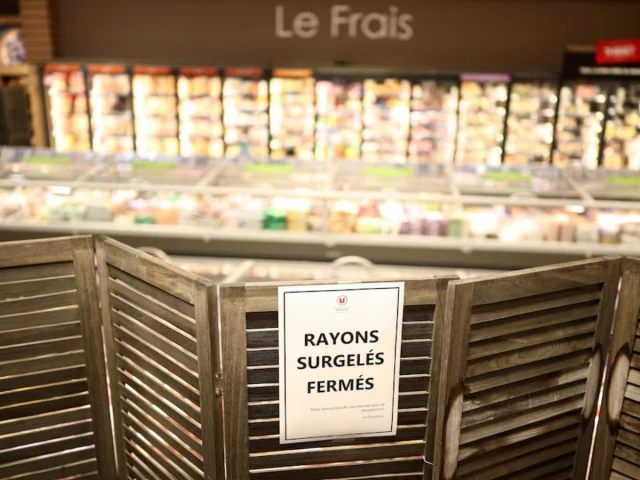
Image: Reuters
On the night of October 11 to October 12, 2026, hackers broke into the refrigeration management systems of hundreds of supermarkets across France. Instead of keeping frozen food cold, they pushed temperatures in freezers and cold rooms up to 50°C (122°F). In one Intermarché store in La Haye, Normandy, the temperature reportedly climbed as high as 80°C (176°F), and some equipment melted.
Charles Dezon, who owns an Intermarché store in Gradignan near Bordeaux, told Le Monde he had to throw away nearly an entire dumpster's worth of frozen food. He only learned something was wrong at 4 in the morning, when a delivery driver found the cold room flooded. "The temperature had reached 50°C in the cold room, which set off a sprinkler," he said. A bailiff confirmed his losses: €21,000 at purchase price.
The scale is staggering. Roughly 500 stores out of France's 15,000 were hit, according to estimates reported by the BBC. Les Mousquetaires, the group behind Intermarché and Netto, said refrigeration at around 150 of its stores was heated to 50°C for six hours overnight. Carrefour reported 80 stores affected, Coopérative U saw about 100 of its outlets targeted, and Monoprix said 5% of its stores had issues. Security researcher Félix Aimé of Sekoia told Reuters that Spain, Portugal, Poland, Germany and Belgium were hit too.
How hackers turned freezers into ovens

Image: Danfoss
Here is how the attack worked, in plain terms. Every modern freezer has a defrost cycle: a short period (usually about an hour) when a small heater switches on to melt frost buildup, so the freezer keeps running efficiently. It is a normal, harmless maintenance step.
The attackers forced the refrigeration systems into continuous defrost mode. What normally runs for short bursts overnight to clear frost instead ran for hours with the heaters engaged. Freezers became warming cabinets. And the hackers were clever about hiding it: according to Le Monde, they stretched the defrost cycle from one hour to eight hours so that temperature alarms would trigger much later, delaying any response and increasing the damage.
How did they reach the freezers? Supermarket cold aisles are controlled by central control panels that manage every fridge and freezer in a store, and those panels can be accessed over the internet so maintenance companies can adjust them remotely. That remote convenience became the open door.
The weak link: outdated firmware
France's national cybersecurity agency, ANSSI, identified a vulnerability in software supplied by Danfoss, the Danish manufacturer behind many of these refrigeration systems. Danfoss confirmed it was "aware of incidents in France affecting a limited number of refrigeration management systems," adding that the affected units were "running outdated firmware" and that it had "long advised customers to keep supported systems updated with the latest firmware and to migrate legacy systems to current-generation solutions."
This was not a surprise to the security community. In August, researchers at Claroty's Team82 published research detailing vulnerabilities in the Danfoss AK-SM 800A controller, including flaws that could let attackers bypass authentication controls and run their own code on the devices. Danfoss issued software updates at the time. But many operators kept running legacy hardware: upgrades cost money, and downtime disrupts business. The French attack is what happens when those warnings go unheeded.
Reuters also reported that the attacks resemble disruptions at about a dozen US military commissaries in late August that led to food losses after fridges were affected.
The fallout: millions in spoiled food, a national investigation
The damage bill is still being counted, but it is large. Two stores in the Alsace region, one Intermarché and one Super U in Haguenau, together lost goods worth €270,000. Nationwide losses could reach several million euros, as entire stocks of fresh and frozen items had to be discarded. Because of the broken cold chain, stores could not risk selling any of it; everything in the affected units went in the trash.
The response was swift:
- The Paris prosecutor's office opened an investigation into the "large-scale" attack affecting connected refrigeration systems at major food retailers.
- Prime Minister Sébastien Lecornu instructed ANSSI to investigate and began coordinating with European partners, since other countries were affected too.
- EU agriculture and food commissioner Christophe Hansen condemned the attack, writing that "the weaponization of food has become a reality."
Dominique Schelcher, CEO of Coopérative U, wrote on X that "targeting equipment essential to the preservation of fresh products and to the food supply of the French people is of extreme gravity and is unprecedented."
Separately, Dutch retail giant Ahold Delhaize (owner of Albert Heijn) reported a "security issue" on its own network and took systems offline, though it said it saw no link to the French incidents.
What this means for the rest of us
This attack matters even if you live far from France, because the lesson is universal. Here are the practical takeaways:
- Cybersecurity is no longer just about computers. Operational technology, the controllers that run freezers, pumps, traffic lights and power grids, is now a prime target. Attackers do not need ransomware or data theft; they can just break things.
- Remote access is a double-edged sword. Being able to adjust equipment from anywhere is convenient, but every internet-connected control panel is a potential entry point. Isolate critical systems from the public internet wherever possible.
- Updates are not optional. The affected Danfoss units were running outdated firmware. Patching old systems is boring and expensive, until the alternative is throwing away millions of euros of food.
- The cold chain is fragile. The food you buy depends on an invisible network of sensors and controllers staying at the right temperature. When that fails, shelves empty fast.
No group has claimed responsibility, and the motive remains unclear. Financial gain through ransomware seems unlikely: the attackers simply destroyed value. What is clear is the attack's simplicity. No sophisticated malware was required. Access to the controllers was enough to issue the destructive commands, and hundreds of stores are still paying the price.
For more Cybersecurity news and more Technology news, browse the blog's topic pages.
Sources: Le Monde, Reuters, CTech
Discussion
// Sign in with Google to join the discussion (Settings → Comments to change who can comment)